Ryder Cup 2025: Team Europe’s VR Revolution—McIlroy and Rahm Prepare for the Battle at Bethpage Black
 admin
admin 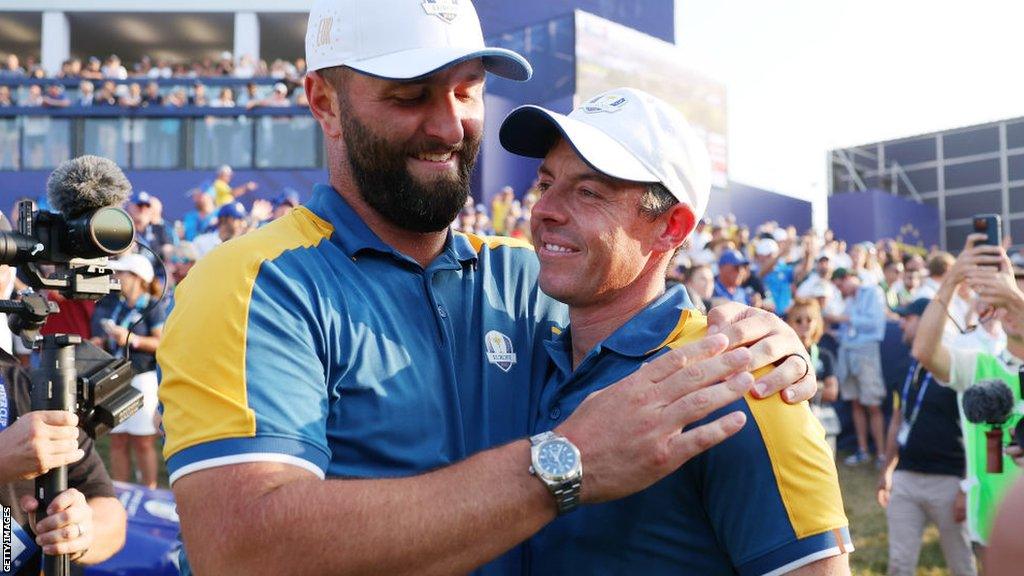
The Ryder Cup is without a doubt one of the most exciting events in golf. It features tension and competition in the bi-annual battle between Europe and the USA. With the next Ryder Cup scheduled for Bethpage Black in 2025, buzz and excitement for the Cup is already high. Here’s a crazy twist: Team Europe is using VR headsets to test one of the more intense courses in golf. They are trying to master the noise and chaos of the course. McIlroy and Rahm recently shared how this new train of thought is very helpful. It’s time for Europe to figure this out, the match is going to be crazy.
Why is mental focus so tough at Bethpage Black?
To anyone new to the Ryder Cup, it is a showcase of golf magic. It’s so much more than just the birdies and bogeys, it’s a battle of nation pride for the players. Bethpage Black, the set for 2025, has its share of theater.
When the Ryder Cup was last hosted in the USA in 2002, the home team drew their energy from the sometimes overwhelming crowd to achieve a record-breaking victory. The chanting, booing, and noise targeting the European players was fierce and completely unhinged. They’re coming in 2025. Team Europe this time has a surprising technological solution. In the heat of competitive and rowdy crowd, players experience intensely charged focus and need to maintain sharpness. That’s where the magic of VR comes in. If Europe can replicate the crowds, they’ll take the vehicles competing for the distractions on the fortress, and win all the same. Players need to avoid the level of noise and chaos.
VR: The McIlroy and Rahm Experiments

Rory McIlroy and Jon Rahm have stated that much of the Team Europe buzz stems from the coaching staff’s reports around VR headsets that simulate the chaos of a Bethpage Black and its respective crowds. Picture yourself within a virtual reality environment, reconnecting to the headsets, and being the main protagonist in a hyper-realistic simulation of a grandstand, with virtual USA fans chanting, “USA! USA!”, and mock and heckle!
Think of it as a golf-related spinechiller but the goal is to boost mental strength rather than to scare you out of your mind.

McIlroy as the ever Captain, said, “We’ve all experienced tough crowds, but Bethpage in 2002 was on a different level. This VR stuff is brilliant. It’s not just feeling the shots and picturing the trajectories. It’s feeling the pressure. During our sessions, I could hear the crowd booing and the tension in the air was unreal. I practiced turning that energy into focus and it was a mental workout in itself. If we can learn how to harness that now, I think we’re going to shredd the course in 2025. ”.
Jon Rahm, even with the switch to LIV Golf, shared his experience: “I love to see creativity in all aspects and this VR performance is wildly out of this world. I was in a calm practice facility and the moment the headset was on, it was like I was in a major with 50,000 spectators. It isn’t perfected and there a few glitches, but the VR simulations are bone chilling and I literally almost hit a heckler. However, these practice sessions are perfect for the mental battle we are going to face in the Ryder Cup. Europe’s strength is unrivaled, but let me tell you, this is going to build our mind for the battle.”.
The research isn’t just a gimmick, but is a product of sports psychologists and technology wizards.
VR systems have incorporated 360-degree video, spatial audio, and even haptics to replicate the intense feel of real-life events. Scenarios can be customized. With the utmost realism, one can imagine critical moments like the 18th hole and the final putt. Traditional mental training is a far cry, as it often consists of meditation and visualization.
Why This Could Change the Game
This is the first glimpse of how golf is breaking free from the confines of the golf course. As Technology embraces, and is embraced, by athletes in different spheres of sport—NBA players doing defensive drills in VR, soccer teams practicing with crowd simulations—Team Europe demonstrates technological readiness is not the exclusive domain of the young. They are shifting the focus in mental preparation, which has been a “drying out” area in past Ryder Cups, when the crowd energy rattled European players.
The results are better focus, less anxiety, and better teamwork. McIlroy and Rahm have, I’m told, been teasing each other about some virtual golf rigmarole, which is a great way to build team cohesion and laughter on the course. Even better, Rahm’s Ryder Cup eligibility is intact thanks to the its nationality-based rules. This would have added to the “us against the world” mentality—uniting players from different tours.
You can be sure Team USA hasn’t missed out on this.
While other regions are coming up with their own plans, Europe’s attempts seem to be well ahead of other regions, which gives them an advantage. If the VR technology turns out to be useful, it might even change the way future Ryder Cups are prepared, putting the same significance to mental training as they do on physical training.
Looking Ahead to Ryder Cup 2025
The Ryder Cup at Bethpage Black, set for September 2025, is practically a locked scheduled view, with significant players like McIlroy and Rahm in the lineup to charge at it, and with the addition of this VR experiment, it is changing the way sports psychology is perceived. Does Europe’s technology give them the edge they need to reclaim the trophy, or is the USA’s home advantage too dominant? Regardless of the answer, it is implicit that the energy will be sky-high, and with the help of VR, players from Europe’s team will be prepared for whatever lies ahead.